
Latest national wage data
Salary information
Nurse Anesthetists
$236,590 median per year
See full salary breakdown
| 10th percentile | $155,250 |
|---|---|
| 25th percentile | $206,730 |
| Median | $236,590 |
| 75th percentile | $294,350 |
| 90th percentile | $339,500 |
Source: U.S. Bureau of Labor Statistics, May 2025 OEWS. National estimates for wage and salary employees. Self employed workers are not included. Last reviewed: September 6, 2026.
Direct answer
What you should know
Nurse anesthetists, often called CRNAs, are advanced-practice registered nurses who provide anesthesia and monitor patients before, during, and after procedures. The pathway requires RN preparation and experience, a graduate nurse-anesthesia program, national certification, and state authorization.
Responsibilities and work setting
Typical responsibilities
- Assess patients and develop an anesthesia plan.
- Administer anesthesia and continuously monitor vital functions.
- Manage airways, pain, emergence, and recovery from anesthesia.
- Respond to complications and coordinate with surgeons, physicians, nurses, and procedural teams.
Where the work happens
- Hospitals, surgical centers, physician and dental offices, military facilities, and pain-management settings.
- Work may include long procedures, shifts, on-call coverage, and high-stakes emergency decisions.
Education, licensing, and experience
- Become a licensed RN and obtain required critical-care experience.
- Complete an accredited doctoral-level nurse-anesthesia program for current entrants.
- Pass national certification and meet state advanced-practice requirements.
Employment outlook, 2025–2035
BLS projects faster-than-average growth and continued demand across surgical and procedural settings.
| Occupation | SOC | Growth | Annual openings | Typical entry path |
|---|---|---|---|---|
| Nurse anesthetists | 29-1151 | 9.7% | 2,400 | Graduate degree; RN/APRN authorization |
Employment and openings are U.S. Bureau of Labor Statistics national projections. Openings are annual averages over the 2025–2035 projection period and include replacement needs.
Sources and review
- BLS Occupational Projections and Worker Characteristics
- BLS Nurse Anesthetists, Nurse Midwives, and Nurse Practitioners OOH
Last reviewed: September 6, 2026. Editorial and data review: BobUSA, site editor. Wage figures use May 2025 OEWS data; outlook figures use the 2025–2035 BLS Employment Projections.
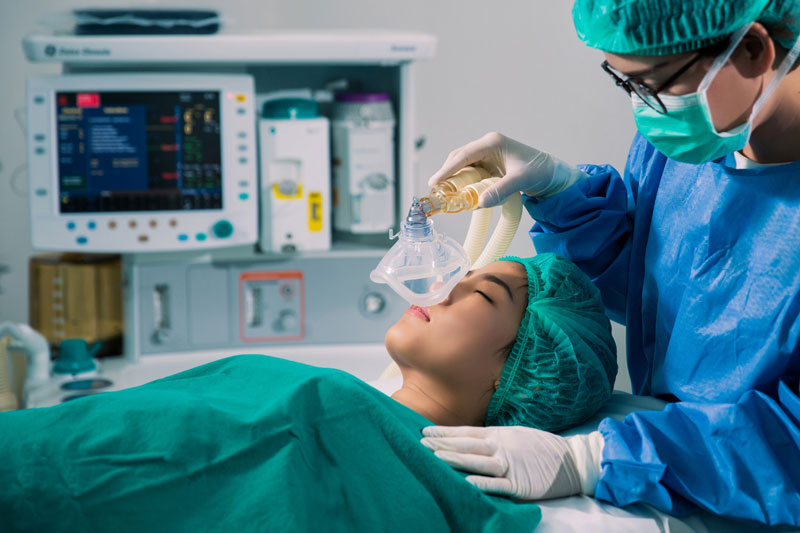
The nurse works in a team and needs to communicate effectively with the patients and other team members in order to prepare the best anesthetic agents.
What Nurse Anesthetists Actually Do?

The nurse anesthetist also called CRNA (Certified Registered Nurse Anesthetist) needs to be professional yet compassionate, to explain the procedures to patients, to monitor them constantly, and to help them stay at ease.
Prior to the workflow of any anesthetic, the nurse carries out an evaluation of the type of patient and determines the amount of anesthesia needed. The patient’s health condition always must be considered.
Sometimes a patient encounters health problems that can lead to a high-stress situation. It is crucial to be able to work well under pressure. The track is often full-time, although there are some part-time positions available.f
Depending on the medical procedures, the nurse anesthetist may have to work long hours. Some jobs can provide daytime hours while the other jobs will have to be carried out at night. This job may have minimal physical requirements, but it requires strong mental health.
What Are The Responsibilities Of A Certified Registered Nurse Anesthetist (CRNA)?

Certified Registered Nurse Anesthetists (CRNA) in the USA provide anesthesia needs of the patient before, during, and after the operation or the delivery of a baby. Here are some of the responsibilities of a Nurse Anesthetist:
- Manages the respiratory or pulmonary function of patients with techniques such as endotracheal intubation, mechanical ventilation, pharmacologic carrier, respiratory therapy, and intubation.
- Assess medical histories of patients to predict anesthesia reactions.
- Prepares prescribed solutions and the management of the local, intravenous, and spinal anesthetics or other methods specified methods and procedures.
- Selects or administers anesthetic agents, adjuvant drugs, accessory drugs, fluids, or blood products that are needed.
- Develops anesthesia care plans.
- Monitors patients for skin tone, pupil dilation, pulse, heart rate, blood pressure and respiration, ventilation, or urine production, using invasive and non-invasive techniques.
- Selects or prepares the equipment, monitors, supplies, or drugs to administer anesthetics.
- Obtains informed consent from patients for anesthesia procedures.
- Responds to emergencies to all in-house codes by providing airway management, emergency management fluids or drugs, or using basic or advanced cardiac life support
- Performs local anesthetic techniques such as spinal, local, epidural, tail, nerve blocks, and intravenous blocks.
- Keeps up with the knowledge of current trends and developments in the medical field by reading corresponding literature and books, attending related seminars, etc.
Where Do Nurse Anesthetists Practice?

The Certified Registered Nurse Anesthetists (CRNAs) in the USA perform their practice in a range of facilities in the public and private sectors and in the US Army, including:
- traditional hospital operating rooms
- ambulatory surgical centers
- pain clinics and
- doctors’ offices.
They perform on an individual basis and in groups together. Some CRNAs have independent contracting arrangements with physicians or hospitals.
What Is The Average Salary For A Nurse Anesthetist in The USA?
The average salary for a Nurse Anesthetist is $163/year (as of 2022). The total cash earnings of the Nurse Anesthetists range from $111K to $202K on the high end.
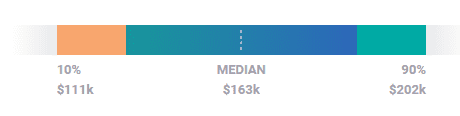
Base Salary | $111k - $202k |
Bonus | $592 - $20k |
Total Pay | $112k - $216k |
However, the salary for someone with the title “Certified Nurse” depends on several factors, such as:
- years of experience
- company size
- education
- location
- industry
The reason for the high pay is mostly related to the high levels of legal responsibility and liability of those anesthesiologists. Anesthesiologist’s greater control over life and death and the circumstances giving medications that are extremely sensitive.
CRNAs are in high demand and thus have many options for general or special practice in the United States.
CRNA Education And Training

Becoming a CRNA will take at least 7 years of full-time experience and training.
This position takes so long because it typically requires nurse training, specific medical training, and certification in nurse anesthesia.
People who want to become CRNA first have a Bachelor of Science in Nursing (BSN) or bachelor’s degree in another appropriate subject and at least one year of experience as a nurse in acute care nursing.
Next undergraduate work, future nurse anesthetists earn a Master of Science (MS) degree, Certificate of Advanced Graduate Study (KG), or Doctor of Nursing Practice (DNP) degree from a school of nurse anesthesia, in which clinical experience with multiple methods includes anesthesia. After that nurse anesthetists must have a national certification exam.
All nurse anesthetists must possess a valid state license as a registered nurse anesthetist accredited by the American Association of Nurse Anesthetists (AANA), which will allow them to work in a hospital, clinic or private practice.
Final Words
Certified nurse anesthetists (CRNAs) belong to a high demand and highest-paying job because of their numerous responsibilities. Besides the medical requirements and duties, CRNAs should also have the ability to pay close attention to detail and build-in a desire to help other people.
A nurse anesthetist must possess excellent communication skills (verbal and written) for dealing with stressful situations.
The ability to work well in pressure-packed situations is a must. That’s why it’s very useful for nurse anesthetists to have a calm and reassuring attitude, even in stressful times.
At the end, they should also be organized, quick and efficient, active listeners, and good reputation-keepers… which makes them perfect people for a high-rewarded job such as CRNA.
Updated automatically
Current job openings
The occupation is already selected. Change the optional location or use a role tab to refine the live results.
Loading current openings…
JavaScript is required to load the live CareerJet results on this page.